
Can You Get a Personal Loan with a Bad Credit Score?

Many lenders offer personal loans for low credit score borrowers, though eligibility and terms vary depending on the lender's criteria and overall assessment of the applicant's financial situation. Banks generally require higher scores since they lend at scale and rely on quick, rule-based filters.
However, NBFCs (Non-Banking Financial Companies) and digital lenders often take a broader view, weighing your income and recent repayment behaviour alongside the score itself. This means a low score may limit your options rather than eliminate them. Your chances of approval can also improve with a co-applicant, collateral, or proof of stable income.
What is the Minimum Credit Score for Personal Loan Approval?
There's no fixed cut-off that all lenders in India follow. Each one sets its own threshold based on how much risk it's willing to take, and this usually varies by institution type. However, a higher score opens the door to more lenders and better terms, while a lower score can mean stricter conditions and extra requirements. The table below shows which types of lenders are more likely to consider your application at each range.
| Credit Score | Lenders |
|---|---|
| 750+ | PSU banks, best rates |
| 700–749 | Private banks, standard rates |
| 650–699 | NBFCs, slightly higher rates |
| 600–649 | Digital/fintech lenders, high rates, lower ticket size |
| Below 600 | Very limited - secured loan or co-applicant route recommended |
These ranges are indicative only. Individual lender eligibility criteria may vary*
What Happens to Your Loan Chances When Your Credit Score is Low?
A low score doesn’t shut the door, but it does change the terms you are offered. The following typically change:
- Higher interest rates: Lenders price in the added risk, so your EMI will likely be higher than someone with a stronger score.
- Smaller loan amounts: You may be offered less than you asked for, at least the first time around.
- Stricter documentation: Expect closer scrutiny of your proof of income, bank statements, and existing obligations.
- A guarantor or collateral requirement: Some lenders will only proceed if you can offer security or bring in a co-applicant.
- Possible rejection from traditional banks: Approval from traditional banks may be more difficult at this range, making NBFCs and digital lenders a more practical option.
Missed an EMI?
Learn how late payments affect your credit score and the steps you can take to recover.
How to Get a Personal Loan with a Bad Credit Score
A low credit score can make borrowing more difficult, but it does not eliminate your options. Lenders often look beyond the score itself and consider the following factors:
- Apply through an NBFC or digital lender
NBFCs and digital lending platforms often have more flexible underwriting than traditional banks. They may consider applicants with lower credit scores if income is stable and repayment behaviour is improving, though usually at a higher interest rate and sometimes a shorter tenure. - Add a co-applicant with a good credit score
Bringing in a co-applicant-often a spouse, sibling, or parent with a healthier credit profile-can shift how a lender views your application. It spreads repayment risk across two incomes and credit histories, which can mean better loan terms, not just improved approval odds. - Offer collateral or an FD-backed loan
Turning an unsecured request into a secured one changes the risk equation entirely. Collateral like fixed deposits or gold gives the lender a fallback, often meaning a lower interest rate and higher approval odds. - Show proof of stable income
A credit score reflects past repayment behaviour, while income shows ability to repay in future; both matter to lenders. Salary slips, ITRs, or steady business banking statements that show stable earnings can strengthen an application, especially with a lower score.
Can I Get a Personal Loan Without a Credit Score?
For first-time borrowers, the real challenge is no credit history rather than a low score. With no track record to assess, lenders lean on income stability, employment, existing obligations, and bank activity. This makes NBFCs and digital lenders a better option. Some lenders may also ask for a guarantor, collateral, or an FD-backed arrangement to reduce risk. Additionally, the first loan may be modest, but timely repayment will build your credit history, opening the door to larger loans and better terms.
For a step-by-step plan tailored to the Indian credit system, read our full guide on how to improve your credit score before your next application.
Eligibility Criteria for a Personal Loan with a Low Credit Score
Even with a low score, most lenders will still evaluate you against a standard set of criteria:
- Age: Typically between 21 and 60 years.
- Income proof: Salary slips or bank statements for salaried applicants; ITRs and business financials for self-employed applicants.
- Employment type and stability: Salaried and self-employed applicants are assessed differently, but consistency in either matters.
- Existing obligations: Any ongoing EMIs or credit card dues will be factored in.
- Debt-to-income ratio: Lenders prefer your total monthly obligations to stay well within your income; a lower ratio helps, especially when your score is a concern.
If a previous loan has been written off on your report, it can significantly restrict your borrowing options. Learn what happens when a loan is written off and the steps to recover.
How to Improve Your Credit Score Before Applying
If your loan isn't urgent, improving your credit score first can expand your options and get you better terms.
- Clear overdue payments: Outstanding EMIs or unpaid credit card balances hurt your score most; address these first.
- Lower credit utilisation: Keep usage below 30% of your limit.
- Avoid multiple loan applications: Each application triggers a hard inquiry; too many in a short span can drag your score down.
- Check your credit report: Dispute errors like accounts that aren't yours or wrongly reported overdues right away.
Case Study: Personal Loan with Bad Credit – Rahul's Story
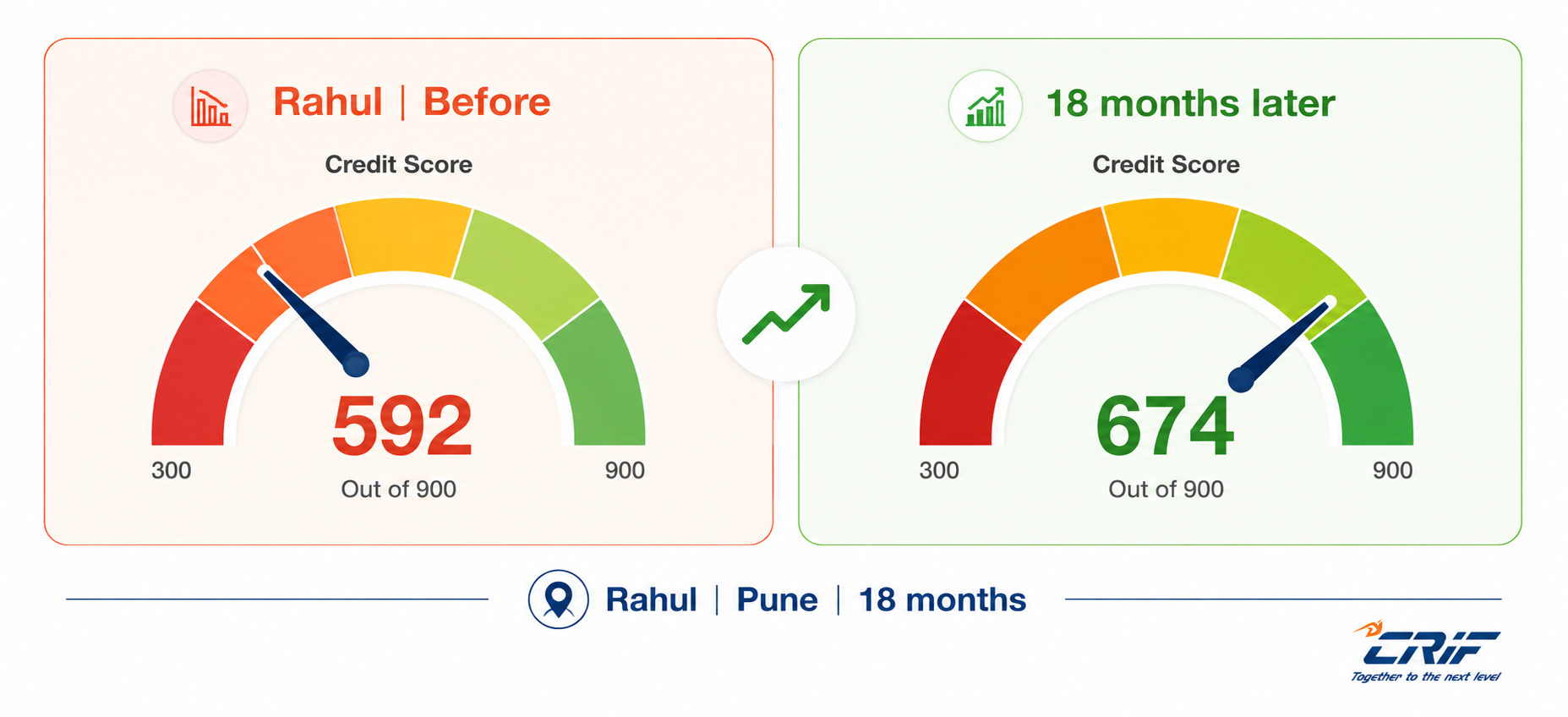
Rahul, a 29-year-old sales executive from Pune, had a credit score of 592 after missing an EMI two years earlier. When a family medical emergency meant he needed ₹2 lakh urgently, three banks declined his application.
To improve his chances of approval, Rahul:
- Applied through an NBFC rather than a traditional bank.
- Added his sister, who had a credit score of 731, as a co-applicant.
- Set up auto-debit instructions to ensure every EMI was paid on time.
These steps helped him secure a loan at 18.5%. By repaying every EMI on time over the next 18 months, he raised his score to 674. This allowed him to secure his next loan at just 13% from a private bank.
From the Bureau's Desk
A single co-applicant with a healthy credit profile can meaningfully improve the terms you're offered. It also distributes repayment responsibility, making lenders more confident in the arrangement.
A Low Credit Score Does Not End Your Options
Borrowers seeking a personal loan with bad credit still have options. While a lower credit score may limit the number of lenders willing to approve an application, factors such as stable income, collateral, or a creditworthy co-applicant can help strengthen your profile. Comparing lenders is important, as eligibility criteria vary across banks, NBFCs, and digital lenders. If possible, improving your credit score before applying may also increase your borrowing options and help you secure better loan terms.
Frequently Asked Questions
1. What is the minimum credit score for a personal loan in India?
Most banks prefer a score of 750 or above. NBFCs may consider applicants from around 650, and digital lenders sometimes go as low as 600.
2. Can I get a personal loan with a 600 credit score?
Yes, this is possible through select NBFCs and digital lenders, though usually at higher interest rates and with smaller loan amounts.
3. Which type of lender offers personal loans with a low credit score?
NBFCs and digital or fintech lenders are generally more flexible than PSU or private banks when it comes to lower credit scores.
4. Does applying for a personal loan hurt my credit score?
Each hard inquiry can lower your score slightly. It's best to avoid applying to multiple lenders within a short period.
5. How long does it take to improve a credit score for a loan?
With consistent, on-time repayment, most borrowers see meaningful improvement within 6 to 12 months.
Disclaimer: This article is intended for general educational purposes only and should not be considered financial or legal advice. Credit reporting timelines, CRIF Credit Score calculations, and lender policies may vary. Always verify your account details with your lender and refer to your latest CRIF HighMark credit report for the most accurate information.
Written by: CRIF Editorial Team | Published: August 2026 | Last Updated: August 2026